

What’s the best gaming chair for short people? Objectively, gaming and ergonomic office chairs have the same purpose: supporting neutral sitting postures through core adjustable features (lumbar support, armrests, recline). So let’s test real-world geometry against manufacturer claims to pinpoint the best models for sizes 5’4″ (163 cm) and shorter.

We start our real-world tests with the Steelcase Leap V2 (rated for sizes 5’4″+) vs the Herman Miller Aeron Size A (rated for sizes 4’10″+). Size ratings seem inaccurate.
The 5’3″ tester fits well in the Leap at its lowest settings, with planted feet and a two-finger gap behind her knees. Conversely, the 5’2″ Aeron tester cannot plant her heels, while the rigid seat edge pushes directly against the back of her knees.
Meanwhile, the smallest gaming chair for short people is the Secretlab Titan Evo. Its 4’11” minimum size rating looks absurd when tested with a 5’6″ model, with a seat too high and deep for her size.

But there’s a catch: add a footrest, and the fit resolves.
Best-Fitting Ergonomic Desk Chairs For Short People
These real-world tests give us hard anthropometric data to accurately rank the best fitting ergonomic chairs for users 5’4″ and under:
| Chair Features & Price | Manufacturer size rating | Size rating without footrest |
| Steelcase Leap V2: 4D arms, 96-120° recline, sync seat tilt, 4D lumbar (up/down, forward/back), 12-year warranty, from $1499 | 5’4″ to 6’2″ | 5’2″ to 6’2″ |
| Herman Miller Aeron Size A: 3D arms, 93-104° recline, sync seat tilt, 2D lumbar (choose up/down or in/out), 12-year warranty, from $2305 | 4’10” to 5’9″ | 5’3″ to 5’9″ |
| Steelcase Amia: 4D arms, 96-120° recline, sync seat tilt, 2D lumbar (up/down), 12-year warranty, from $1099 | 5’4″ to 6’2″ | 5’3″ to 6’2″ |
| Secretlab Titan Evo (S): 4D arms, magnetic headrest, 85-165° recline, multifunction seat tilt, 4D integrated lumbar(up/down, out/in), 5-year warranty, from $569 | 4’11” to 5’6″ | 5’7″ to 5’9″ |
Affordable (under $500) alternative: Cablady S2 Petite (sizes 4’9″+).
Key takeaways
Our 5’3″ Leap model wore shoes, our 5’2″ Aeron tester was barefoot, and our 5’6″ Titan Evo tester used a footrest. This real-world spread gives us clear sizing takeaways for users 5’4″ and shorter:
- Seat depth is the primary bottleneck. The Aeron Size A drops to a lower minimum seat height (14.75″) than the Leap V2 (16.0″). Yet, the Aeron fails a 5’2″ user because its 16.75″ rigid seat lip jams behind her knees, forcing her legs forward and pulling her heels off the floor.
- Footrests are mandatory for short people. Most ergonomic chairs lack the low cylinder drop needed for small frames. Compounding this, standard 28″–30″ desk heights force shorter users to raise their seat to reach keyboard level. Combined, these factors make a footrest essential for users 5’4″ and under.
- Footwear acts as a natural height adjuster. A 5’3″ user can sit flat-footed in the Leap V2 at a 16.0″ seat height because standard shoes add 1-1.5″ of popliteal elevation. Barefoot sitters lose this clearance.
Best Small Gaming/ Office Chairs
Gaming chairs and ergonomic office chairs are both designed to support neutral postures using the same adjustable trio (lumbar support, armrest, recline).

Thus, the ‘best model’ for short people will be the one that fits their body type. Top options:
Steelcase Leap V2
Check Amazon price | Seat: 15.75″(D), 16″ (H)
The Steelcase Leap V2 tops the small chair category with premium ergonomics, elite brand prestige, a 12-year warranty, and the best natural fit for users under 5’4″—without needing a footrest.

For instance, at its lowest seat height (16″) and depth (15.75″), our 5’3″ test model sits in complete neutral alignment. Her heels remain fully planted on the floor, leaving ample popliteal space behind the knees to eliminate thigh pressure.
4.5 out of 5.0 stars

Based on its dimensions and features, the Leap V2 is the best ergonomic desk chair for small sizes. Steelcase rates the Leap V2 for sizes 5’4″+, but our 5’3″ testing model enjoyed a near-perfect fit.
- Manufacturer’s size minimum: 5’4″
- Tested minimum (no footrest): 5’2″
Pros
- Complete adjustable features
- World-class build backed by a 12-year warranty
- Best real-world fit for sizes 5’2″+
Cons
- The high price is justified by the build quality, brand pedigree and warranty. Besides those extras, the Leap provides comparable neutral posture support with other chairs.
- The plain, corporate aesthetics and straightforward features might underwhelm thrill-seekers.
Leap V2 Specifications
Functionality
- Back support: integrated 4-way adjustable lumbar (height x depth)
- Tilt functions: 1° seat sync tilt; 98-125° recline with 5 locking positions
- Armrests: 4D
- Warranty: 12 years
- Seat width x depth: 19.75″ (total W) x 15.75-18.75″ (D)
- Backrest width x height: 18″ (W) x 25″ (H)
- Seat height range: 16″ to 20.5″
- Armrest height range: 7″ to 11″ from the seat
- Size rating (without a footrest):
5’4″5’2″ to 6’2″; 400 pounds
Leap V2 Chair Advice
Without a footrest Leap V2 is the best-fitting option for users 5’2″+. With a footrest, it’s likely capable of supporting sizes as short as 4’10”. Well worth the expense for those who can afford it.
Check Leap V2 prices on Amazon
Also available from Steelcase.com for $1499-$2167 (depending on the upholstery)
Herman Miller Aeron Size A
$2305+ from Herman Miller | Seat: 15.75″(D), 14.75″ (H)
Although rated for users 4’10” and taller, the Small (Size A) Aeron’s seat is clearly too deep and tall for our 5’2″ model. However, Herman Miller wasn’t lying about their size rating—just being sneaky.

Because standard desk heights range between 28″ and 30″, most people 5’4″ and under will need a footrest to type comfortably while keeping their feet supported. When paired with a footrest, the small Aeron should accommodate users 4’10″+ quite well.
4.5 out of 5.0 stars
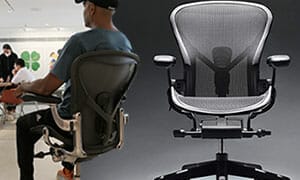
The Aeron’s 8Z Pellicle Mesh adapts with variable tensions zones as the user moves, making it extremely easy to sit in clean neutral postures.
- Manufacturer minimum size: 4’10”
- Tested minimum (no footrest): 5’3″
Pros
- 8Z Pellicle Mesh has variable tension zones that adapt to keep the user balanced as they shift positions
- Iconic aesthetics, a superb build quality and a 12-year warranty help to justify the high price
Cons
- The seat is lined with a hard plastic edge that (without a footrest) will painfully dig into the back of short users’ knees.
- Disappointing limitations for the price: 3D armrests instead of 4D, and a choice of basic height or depth adjustable lumbar supports.
Aeron Specifications
Functionality
- Synchro-tilt: seat pan angle -1° to 16°; backrest 93° to 104°
- Upholstery: Pellicle 8Z mesh provides eight zones of varying tension for ultra-responsive support..
- Seat: adjust the height; limit the tilt range; adjust the tilt tension; sync-tilt with the backrest.
- Backrest: forward tilt option; height and depth adjustable PostureFit lumbar support.
- Armrests: 3D adjustable.
- Warranty: 12 years.
- Seat width x depth: 15.75″ (W) x 16.75″ (D)
- Backrest width x height: 20.25″(W) x 21″ (H)
- Seat height range: 14.75″ to 19″
- Size rating: 4’10” to 5’9″; 300 pounds
Aeron Advice
The Aeron’s 8Z Pellicle mesh makes it very easy to maintain neutral postures over long periods. However, aside from its near-perfect posture support, this is a typical office chair with a good build quality and 12-year warranty.
Steelcase Amia
Check Amazon price | Seat: 15.5″ (D), 16″ (H)
The Steelcase Amia fits our 5’2″ model reasonably well. Its 16″ seat height allows her to plant her feet firmly on the floor, while the 15.5″ seat depth is usable, although the seat’s front edge leaves no clearance behind her knees.

However, this fit reinforces one of our key takeaways: anyone 5’4″ or shorter will need a footrest when using a standard adult-sized desk.
Without a footrest, she’s unable to use the armrests for support while working at a standard 29″ desk. This forces her to raise her shoulders and reach forward, which increases strain on her shoulders, neck, and wrists.
4.0 out of 5.0 stars

A cheaper Leap V2 alternative with more basic lumbar support and recline functions.
- Manufacturer’s size minimum: 5’4″
- Tested minimum (no footrest): 5’3″
Pros
- Cheaper than the Leap with only slightly stripped down features
- World-class build backed by a 12-year warranty
- Excellent fit for sizes 5’3″+
Cons
- Inferior lumbar support vs the Leap (up/down only, no in/out adjustability)
- Basic recline lock: you can lock upright at 96°, or engage the free rocking mode.
Amia Specifications
Functionality
- Lumbar support: height-adjustable
- Recline functions: 1° seat sync tilt; 96-120° recline with upright lock (at 96°)
- Armrests: 4D
- Warranty: 12 years
- Seat width x depth: 19.25″ (W) x 15.5-18.5″ (D)
- Backrest width x height: 18.9″ (W) x 21.25″ (H)
- Seat height range: 16″ to 21″
- Armrest height range: 7.25″ to 11.25″ from the seat
- Size rating (without a footrest):
5’4″5’3″ to 6’2″; 400 pounds
Amia Chair Advice
A solid alternative to the Leap V2 with stripped down lumbar and recline lock features. Based on the fit for our 5’2″ model, the Amia is a perfect fit for sizes 5’3″+. However, to fit at a standard 28-30″ desk in this chair, a footrest is mandatory.
Also available from Steelcase.com for $1099-$1486 (depending on the frame & upholstery)
Secretlab Titan Evo (S)
$549-$594 from Secretlab | Seat: 18.9″(D), 17.7 (H)
3.5 out of 5.0 stars

Provides biomechanically-precise neutral posture support on par with elite office chairs, but with more seating flexibility.
That gives you the freedom to sit as you please, but also makes it easier to adopt sloppy sitting habits.
- Manufacturer size rating: 4’11” to 5’6″
- Tested size rating (no footrest): 5’7″ to 5’9″
Pros
- Its integrated lumbar support matches the best-in-class Steelcase Leap chair’s 4-way adjustable support (up/down, forward/back)
- The strapless magnetic headrest supports perfect 0° neck postures
- More versatile than limited-recline ergonomic office chairs
Cons
- Has the deepest seat (18.9″) with the highest minimum seat height (17.7″). Not ideal for sizes 5’6″ or shorter without a footrest.
- Its recline versatility makes bad posture easier to slip into compared to rigid, task-focused office chairs.
- Some people find the 65 kg/m³ padding too stiff
Titan Evo (S) Specifications
Functionality
- Back support: integrated 4-way adjustable lumbar; magnetic headrest pillow.
- Tilt functions: 11° multifunction seat tilt-lock; 85-165° recline.
- Armrests: 4D armrests with swappable top caps.
- Seat: 65 kg/m³ padding density (firm).
- Seat width x depth: 20.9″ (total W) x 18.9″ (D)
- Backrest width x height: 20″ (W) x 32.3″ (H)
- Seat height range: 17.7″ to 20.5″
- Armrest height range: 26″ to 31.9″
- Size rating: 4’11” to 5’6″; 285 pounds
Titan EVO Advice
I’ve just wrapped up five full-time years using a Secretlab Titan Evo Softweave chair, using it to maintain a biomechanically near-perfect neutral posture for the last four. It’s an outstanding chair.
Without a footrest, our testing shows a user needs to be at least 5’7″ (170 cm) to plant their feet flat while preserving proper popliteal clearance behind the knees. But paired with a footrest, the Titan Evo Small becomes the single viable gaming chair option for shorter frames.
Titan EVO small from Secretlab $519-$594
Related: Titan Evo Sizing Guide
CabLady S2 Petite
Check Amazon price | Seat: 15.7 (D), 17.3″ (H)
Typically priced between $400-$450, this model is rated for sizes 4’9″+. Despite its 17.3″ seat height, a footrest attached to the wheelbase sits around 4″ of the floor, which translates into a 12.3″ seat height at its lowest setting.

It also has a slightly shorter seat (15.7″) than the Leap V2 (15.75″). Based on our sizing calculations, this works out to a size rating of 4’9″ and taller—exactly as advertised.
3.5 out of 5.0 stars

An interesting gaming/ office chair hybrid with unique extras (retractable footrest, adjustable headrest, wheelbase footrest).
- Manufacturer size rating: 4’9″ to 5’11”
- Tested size rating (no footrest): 4’9″ to 5’11”
Pros
- Solid build quality backed by a 3-year warranty
- Includes a removable footrest fastened to the chair’s base (providing support for shorter legs)
- The flip-up armrests also have 2D adjustability
- The adjustable lumbar support is targeted to support female anatomical curves
Cons
- Cabevibe (the chair’s maker) is a relatively new company still in the process of building brand trust
Cablady S2 Features
Functionality
- Armrests: 3D adjustable (flip up, adjust up, adjust forward and back)
- Seat: height and depth adjustable.
- Backrest: recline from 90° to 135°; tilt tension and angle lock in 3 positions.
- Lumbar: height-adjustable
- Extras: retractable footrest, adjustable headrest, bottom foot bracing bar
- Warranty: 3 years.
- Seat width x depth: 20.4″ (W) x 15.75″-18.1″ (D)
- Backrest width x height: 19.5″ (W) x 23.8″ (H)
- Seat height range: 17.3-20.08″
- Size rating: 4’9″ to 5’11”; 330 pounds
CabLady S2 Advice
Having to spend over $1,000 for a chair just because you are short isn’t fair. The Cablady S2 addresses that problem with a dedicated model for petite users.

Compared to super-serious corporate-themed task chairs, it offers a more relaxed, casual option for home environments.
Instead of forcing an upright posture at all times, the Cablady S2 provides the recline range and comfort features needed to kick back and unwind.
Small Gaming Chair Sizing Advice
- Evidence-based size ratings: Accurate chair size ratings based on our real-world fitting tests.
- Footrest benefits for short users: See how a footrest can overcome the fit problems of using a chair that’s too large for your frame.
- Problems caused by poor fit: See how using an oversized chair can lead to discomfort, poor posture, and unnecessary physical strain.
Evidence-Based Size Ratings
To maintain a proper neutral posture (leaving a 2″ gap behind the knees while allowing feet to plant flat) without a footrest, match the seat depth and seat height requirements (scaled down from the 5’3″ Leap V2 baseline test) for your size:
| User size | Maximum seat settings (without footrest) |
| 5’4″ (163 cm) | Max Seat Depth: 16.2″ | Max Seat Height: 15.5″ (16.5″ with shoes) |
| 5’3″ (160 cm) | Max Seat Depth: 16.0″ | Max Seat Height: 15.2″ (16.2″ with shoes — exact Leap V2 cutoff) |
| 5’2″ (157 cm) | Max Seat Depth: 15.7″ | Max Seat Height: 15.0″ (16.0″ with shoes) |
| 5’1″ (155 cm) | Max Seat Depth: 15.4″ | Max Seat Height: 14.8″ (15.8″ with shoes) |
| 5’0″ (152 cm) | Max Seat Depth: 15.2″ | Max Seat Height: 14.5″ (15.5″ with shoes) |
| 4’11” (150 cm) | Max Seat Depth: 14.9″ | Max Seat Height: 14.3″ (15.3″ with shoes) |
As an example, a 5’3″ user needs a maximum seat depth of 16.0″ and a maximum seat height of 15.2″ (or 16.0″ with shoes) to sit unassisted.
Adding a footrest expands these limits, allowing you to add 1.5″ to 2.0″ to the maximum seat depth and 3.0″ to 4.0″ to the maximum seat height.
Footrest Hack for Short People
Technically, Secretlab and Herman Miller weren’t lying about their small chair size ratings—they were just being sneaky. In fact, adding a footrest negates the depth and height shortfall in most cases.
Look at what happens to our 5’6″ Titan Evo model when she adds a footrest:

This “chair sizing hack” isn’t limited to small chairs either. For example, my Titan XL chair (19.3″ seat depth) is a touch long for my 5’9″ (178 cm) frame. Adding a footrest solves the clearance issue instantly:

Look closely at the posture with a footrest engaged and you’ll notice significant biomechanical advantages on top of the sizing fix:
- Relieved knee pressure: Elevating the feet opens the knee angle beyond 90°, pulling the calves slightly forward and creating a crucial safety gap between the popliteal fossa (back of the knee) and the seat’s front edge.
- Reduced posterior pressure: Distributing thigh mass upward reduces downward point pressure on the hamstrings and sit bones—while also promoting a healthier circulation.
- Leveraged neutral contact: The slight backward force from pushing off a footrest drives the pelvis deep into the seat base, naturally forcing stronger engagement between your lumbar spine and the backrest.
Key Takeaway: Based on our real-world fitting tests, users under 5’4″ (163 cm) must use a footrest to achieve a true ergonomic fit in most standard or gaming chairs. Factor this in as an added cost for best results.

On the bright side, a footrest does more than just fix height limitations. It makes neutral sitting easier, leveraging basic kinetic force to keep your back glued to the lumbar support.
Learn more: Ergonomic Footrest Benefits: Sit Taller and More Dynamically
Compounding Dangers of an Ill-Fitting Chair
The cramped fit both users suffered in the previous section’s sizing test isn’t trivial. Over long periods of sitting, the small misalignments caused by a poor fit compound rapidly.

For example, a few years ago I tested a Titan 2020 Series (20.5″ seat depth) with my neighbor’s 5’4″ kid. Despite being too small for the chair, he reported blissful comfort—at first.
However, the excessive seat depth forced his hips forward, compressing his lower back curve into a vise. To keep his feet planted while typing, he had to raise the armrests unnaturally high, causing his neck and shoulder muscles to lock up.
An hour later, he stood up dizzy, disoriented, and visibly exhausted. This was the musculoskeletal chain reaction triggered by his ill-fitting seat:
- Hips curled forward: A seat that’s too deep pulls the hips forward, preventing proper contact with the lumbar support.
- Flattened lower back: As the hips roll forward, the natural lumbar curve flattens out to compensate.
- Rounded upper spine: Flattening the lower spine collapses the base supporting your torso, forcing the head and shoulders to droop forward.
This structural collapse forces your musculoskeletal system to work overtime just to stay upright—the primary reason people feel drained after slumping in bus seats, airplane chairs, or poorly fitted gaming seats.
Related: Ultimate Gaming Chair Sizing Guide
Conclusion: Best Small Chair
Finding the “best” gaming or office chair for sizes 5’4″ or shorter comes down to looking past marketing size claims and prioritizing real-world geometry.

Our testing reveals three lessons for petite users:
- Seat depth is the bottleneck: Even if a chair achieves a low minimum height, a rigid (like the Aeron) or overly deep seat pan will dig into the back of your knees and push you out of neutral alignment.
- Footrests are essential: Because standard desks and office chairs are built for taller frames, pairing a small chair with a footrest is mandatory for users 5’4″ and under to plant their feet and use a keyboard at the same time.
- Footwear matters: Wearing shoes adds 1-1.5″ of popliteal elevation. This can mean the difference between dangling heels and a fully planted, neutral posture.
