


The human body is a masterpiece of adaptation. It doesn’t judge your habits; it simply adjusts to them. If you slouch all day, your body will work overtime to compensate. In contrast, if you adopt healthy sitting habits, the body will reward you with a taller stance, more energy, and a deeper sense of well-being.
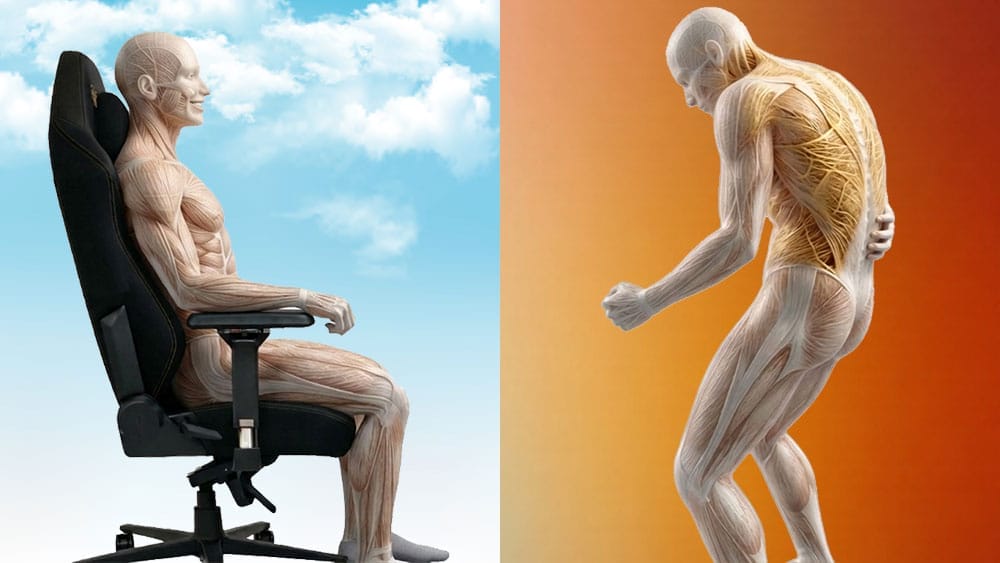
Fascial adaptation is the key to muscle memory programming. Poor postures cause stiffness in the body’s fascia (a fibrous matrix that lies over the organs, muscles, and bones). As muscles adapt, fascia reacts to physical force by producing collagen. This makes fascia stronger and thicker.(1)
In contrast, good posture places consistent, balanced tension on the fascia. This signals the body to lay down collagen fibers in an organized, linear grid(2). Instead of a tangled, stiff “mat” of tissue, the fascia develops into a supple, elastic web that supports the skeleton.
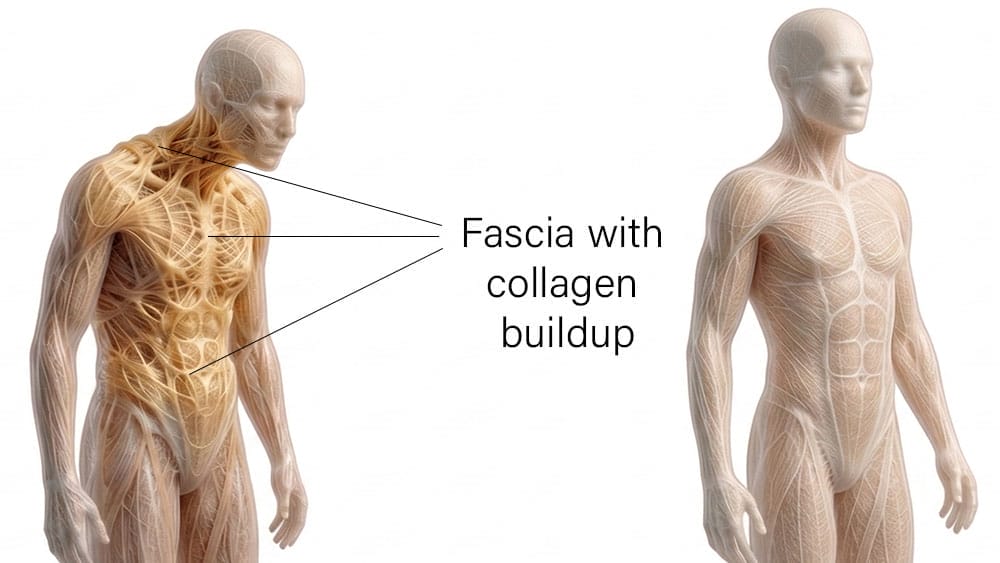
Right: evenly distributed fascia in a well-aligned body.
This alignment allows the layers of fascia to glide over one another using natural lubricants like hyaluronan. As a result, the body stays fluid and mobile rather than “locking” into a restricted shape.
Muscle Memory Programming Toolkit
This article contains everything you need to forge healthy posture habits and develop your fascial system into an elastic, supportive web:
- Using ergonomic seating to program muscle memory: the body adapts to the positions it holds most often. Learn how to capitalise on this by maintaining neutral postures in a gaming or ergonomic office chair.
- Building the core strength to sustain it: holding a clean neutral posture requires strong core and back muscles. This section covers the key exercises to make that possible.
- The science behind muscle memory training: grounded in documented research on muscle memory programming and fascial adaptation — not conjecture.
Key postural takeaway: bad posture builds a “cast” that traps you, while good posture builds a “spring” that holds you up effortlessly.
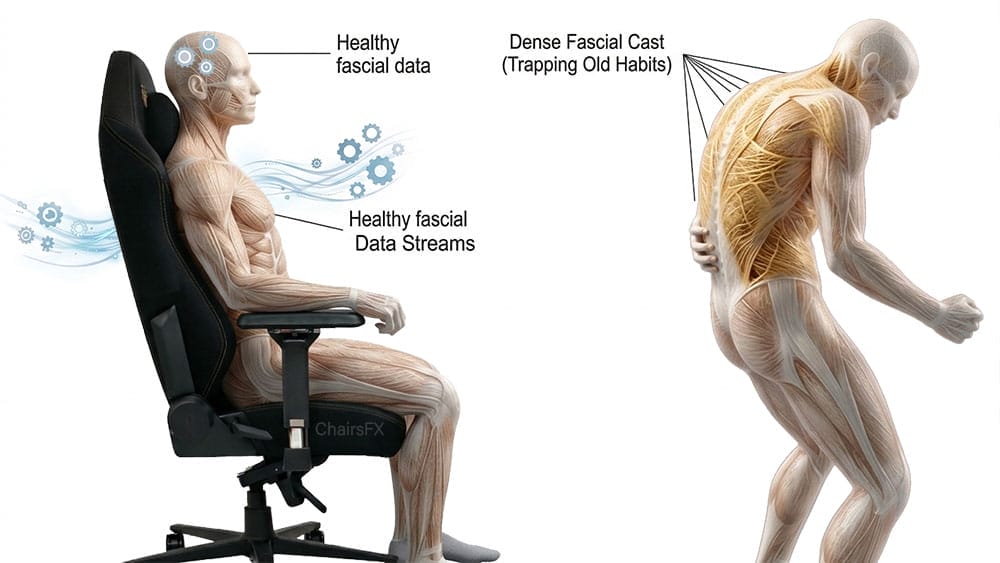
By using an ergonomic chair to enforce a neutral spine, you can physically “knit” a stronger, more flexible internal suit that makes good posture your body’s default setting.
Ergonomic Muscle Memory Programming
Instead of letting posture degrade passively, you can proactively train muscles into healthy habits — starting with a healthy baseline: the neutral sitting posture.
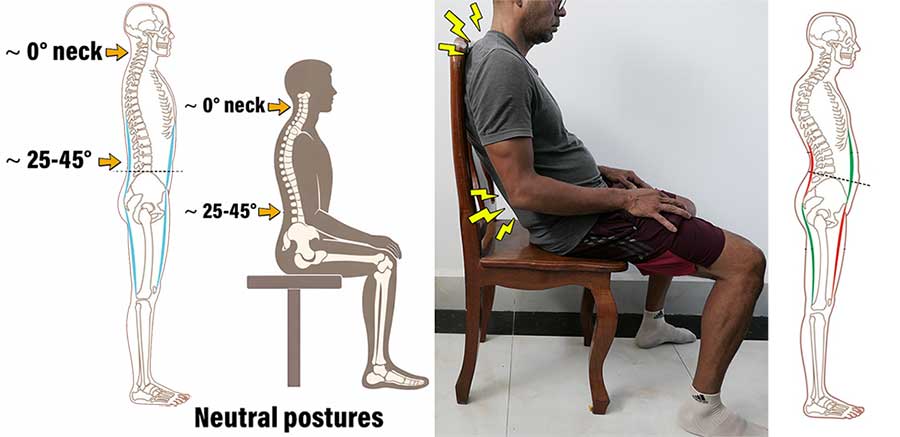
First identified by NASA in the early 1970s, neutral sitting has become the bedrock of modern ergonomic science — cutting through jargon and marketing noise with a definition grounded in decades of research.
Based on over 50 years of accumulated science and leading institutional definitions, any chair with adjustable lumbar support, adjustable armrests, and adjustable recline is equipped to support neutral postures — gaming or office style makes no objective difference.
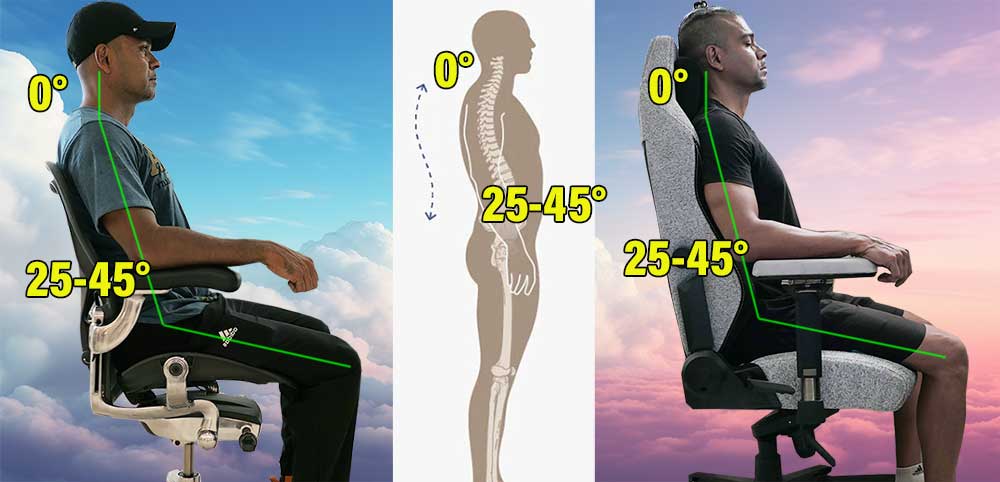
Adopt neutral sitting habits consistently — in either type of ergonomic seating — and your body will adapt.
As Orthopedic Physical Therapist Tanya Snowden puts it: “Once you train the body to know what the proper movement is, body mechanics become so much easier.”(3)
Gaming Chair Posture Therapy
Training muscle memory in a gaming chair isn’t conjecture — I proved it firsthand in 2022 by rehabilitating my text neck, guided by three esports doctors.
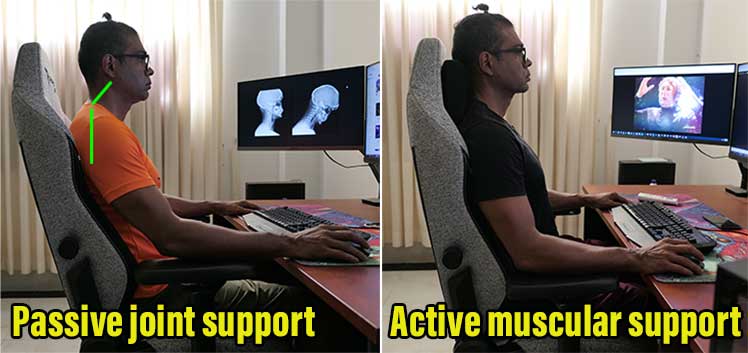
All it took was the right chair settings and two weeks of discipline. Four years later (circa 2026), the results have held: proof that the muscle memory concept is valid.
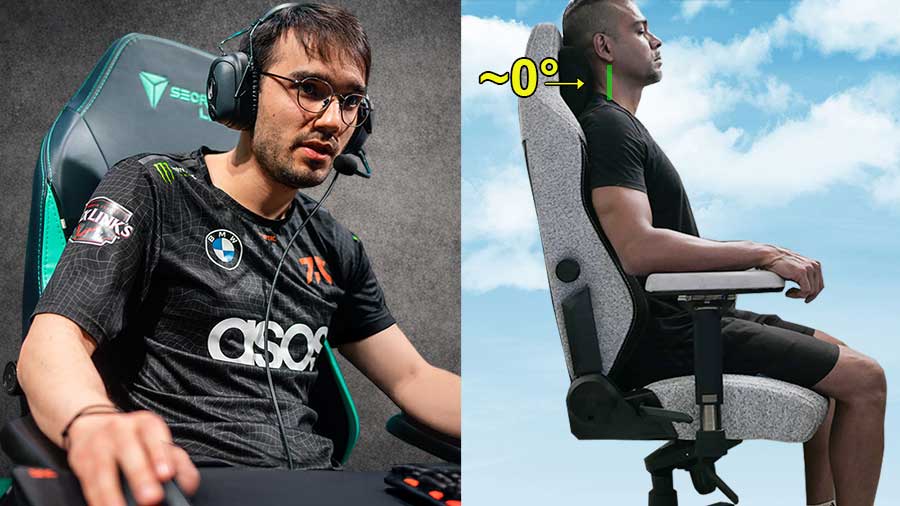
These days, I only need to maintain neutral posture around 50% of the time to preserve those muscle memories — the rest of the time I can sit however I like, with no risk of degradation. Here’s the simple formula:
- Set your gaming chair backrest recline to ~100°.
- Adjust lumbar support to cradle your lower back just above the beltline.
- Consciously prevent your neck from tilting forward.
My experiment proves that two weeks of consistent practice is enough to reprogram muscle memory. Then, good posture runs on near-autopilot.
Ergonomic Office Chair Posture Therapy
Don’t get bamboozled by marketing hype. Institutional ergonomic definitions — backed by 50+ years of ergonomic science make it clear: any chair with adjustable lumbar support, recline, and armrests is equipped to support neutral postures.
Biomechanically, a perfect neutral posture (while sitting or standing) includes a ~0° neck tilt and ~25-45° lower back curve.
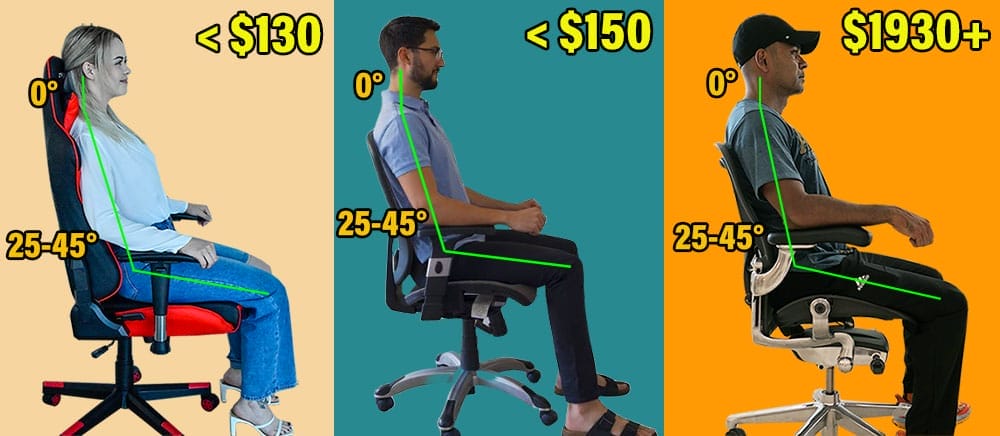
In practice, the theory holds firm. For instance, you can easily achieve those biomechanical benchmarks in a cheap GTRacing gaming chair, a bargain basement Staples Hyken office chair, or a $2000+ Herman Miller Aeron.
As a result, forging neutral muscle memories in an ergonomic office chair is identical to the gaming chair approach:
- Set your office chair backrest recline to 100 degrees.
- Adjust lumbar support to cradle your lower back just above the beltline.
- Consciously prevent your neck from tilting forward.
How to Choose a Good Ergonomic Chair
The primary goal of any type of ergonomic seating is support of neutral body postures. For marketing purposes, this simple objective often gets muddied by subjective entrapments.
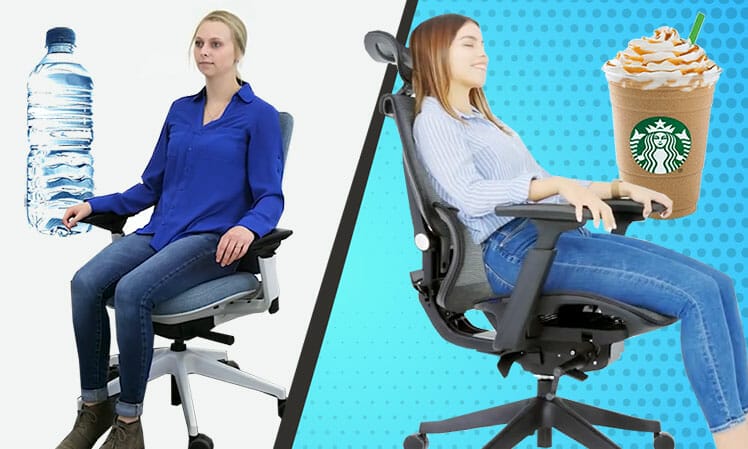
In fact, spending more doesn’t get you ‘better’ neutral posture support — it buys you psychologically appealing extras like nicer aesthetics, longer warranties, and better build qualities.
For ergonomic beginners, subjective extras can become a confusing trap that can actually distort the neutral posture objective. For example, mid-back ergonomic chairs with the necessary adjustable components (lumbar, armrests, recline) support neutral postures just fine.
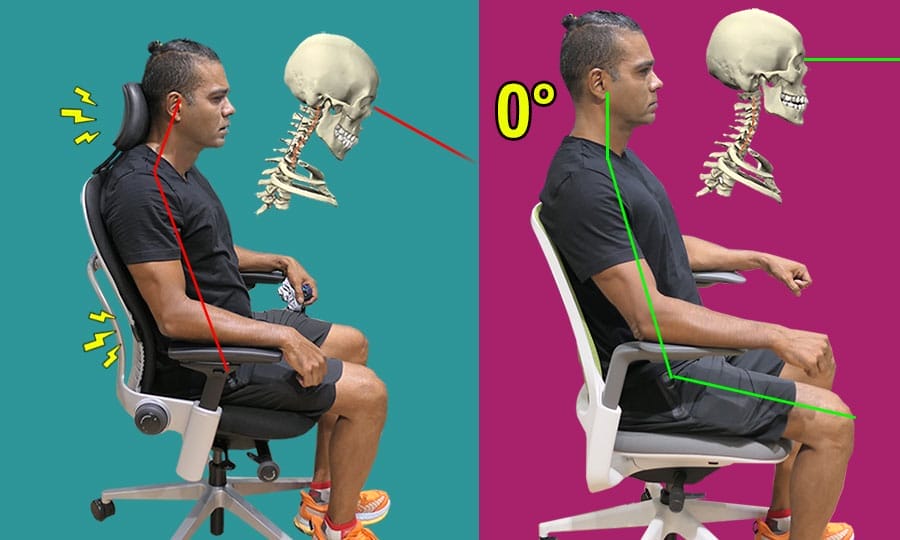
Add a headrest, however, and you introduce a subtle but serious problem: it encourages a forward neck tilt, directly undermining the neutral posture you’re trying to train.
Buying Advice For Ergonomic Beginners
The simple solution is to focus on neutral posture fundamentals while resisting the allure of psychological extras. Follow these steps:
- Fit first: choose a chair that fits your body type. In particular, make sure that the seat isn’t too deep or shallow for your legs.
- Functions second: make sure your ergonomic chair has suitably adjustable lumbar support, armrests, and recline functions.
- Comfort gimmicks last: once you’ve verified the first two steps, indulge your senses by choosing psychologically appealing extras. For example, styling, brand name, warranty, or other such gimmicks.
ChairsFX Picks
Across the ChairsFX website, the Herman Miller Aeron and Secretlab Titan are consistently ranked as the best ergonomic office and gaming chairs available.
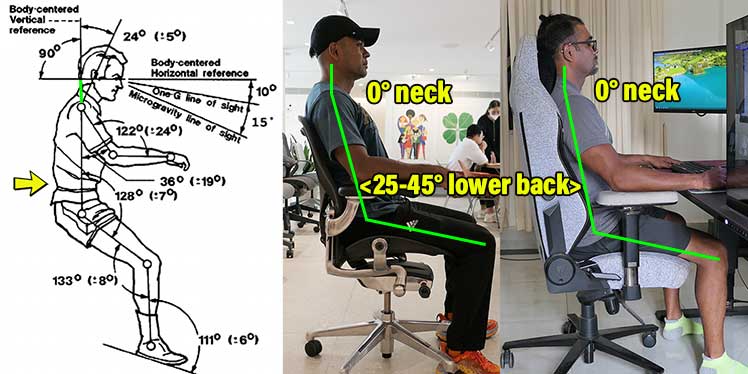
Both come in multiple sizes, support biomechanically perfect neutral postures, and deliver strong psychological extras to justify their price tags.
That said, as Techlead showed in our best programmer chairs roundup, top-dollar spending isn’t required for quality neutral posture support. Use these two chairs as benchmarks, then strip away the psychological extras to find budget alternatives that deliver the same core function:
| Model | Type | Neutral support | Psychological extras | Price |
| Herman Miller Aeron | Office Chair | 1D adjustable lumbar; 3D armrests; 93°, 102°, 113° recline | 12-year warranty, adaptive mesh, iconic aesthetics, forward tilt | $1990 from Herman Miller |
| Secretlab Titan | Gaming chair | 2D adjustable integrated lumbar; 4D armrests; 85-165° recline | 5-year warranty, 60+ flashy styles, magnetic headrest, spacious seat pan | $579 from Secretlab |
Learn more: Best Premium Ergo Office Chairs | Best Premium Gaming Chairs
For budget buyers, the same neutral posture support is available at a fraction of the cost — with fewer psychological extras:
| Model | Type | Neutral support | Psychological limits | Price |
| Staples Hyken | Office Chair | 1D adjustable lumbar; 1D armrests; 100-140° recline | 1-year warranty, basic aesthetics, budget-quality mesh upholstery | Check on Amazon (roughly $150) |
| E-Win Knight Series | Gaming chair | Traditional lumbar pillow; 2D armrests; 85-155° recline | 2-year warranty, basic styling |
More options under $300: Best cheap ergo office chairs | Best cheap gaming chairs
Supplementary Core Strengthening Exercises
The previous sections explain how to use a chair to train neutral posture as your default. Both approaches require setting your recline to 100° and using willpower to hold yourself upright until the habit sticks.
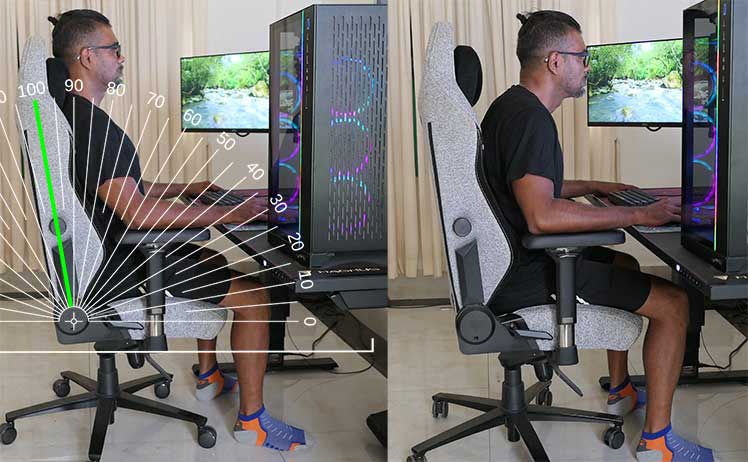
There’s a catch. Two of the three esports doctors who helped me rehab my text neck cautioned that a 100° recline demands genuine core strength — and that most casual users would be more comfortable at a deeper recline of ~115° to ~120° until that strength is built.
Sitting upright at ~100° is demanding by design. The key is consistency: the longer you can hold neutral posture, the faster your body encodes it as the default.
Core strength is what makes that consistency possible. In my experience, adding targeted stretches and strengthening exercises — particularly kneeling lunge stretches and face pulls — meaningfully accelerates the process.
Combined with consistent neutral sitting, most people can expect to feel their posture rounding into form within two to four weeks.
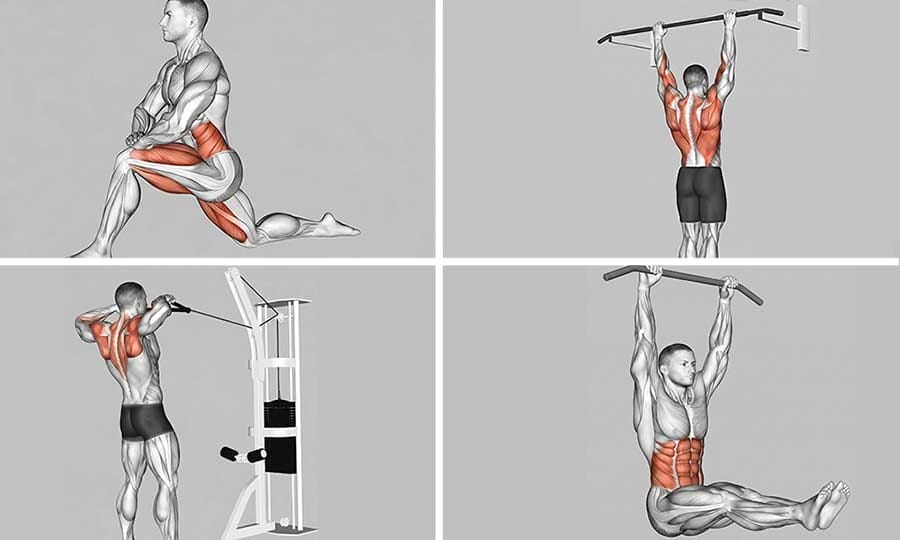
Over four years working with various physical therapists, these exercises have proven most effective:
- Kneeling lunge stretch: lengthens the hip flexors, counteracting anterior pelvic tilt.
- Dead hangs: decompresses the spine and stretches the lats and shoulders.
- Face pulls: strengthens the rear deltoids and upper trapezius, counteracting rounded shoulders and forward neck tilt.
- Hanging leg raises: builds lower abdominal and hip flexor strength for pelvic stability.
- Planks: builds full core stability across the abs, obliques, and deep spinal stabilisers.
Benefits of Core Strengthening
Commit to this process and the rewards compound over time:
- Stand taller. Better posture improves appearance and deepens breathing immediately.
- More energy. A forward neck tilt adds up to 50lbs of load to your neck and shoulders, while a flattened lumbar forces surrounding muscles to compensate just to keep you upright. Train neutral posture and your muscles operate efficiently — freeing up significant energy reserves for focus and cognition instead.
- Greater wellbeing. Standing taller, feeling energised, and sitting for long periods without pain compounds quietly across every area of life.
The Science Behind Muscle Memory Retraining
Understanding the biological mechanisms at work makes the training process easier to commit to — and harder to quit.
Fatigue Destroys Discipline
Sloppy sitting habits and chronic text neck force muscles to work overtime to compensate. That’s one reason why lower back pain is the leading cause of disability in 160 countries.(4)

A direct side-effect of chronically overworked muscles is exhaustion. Around 25% of American adults report suffering from chronic fatigue(5) — yet only 0.5% meet the clinical criteria for Chronic Fatigue Syndrome. For the majority, poor postural habits are a significant contributing factor.
The compounding problem is that fatigue destroys discipline. Under physical or mental stress, people abandon healthy habits(6) — and posture retraining requires consistent effort to take hold.

The good news is that breaking the cycle doesn’t take long. By committing to neutral posture in an ergonomic chair, you give your body’s fascial system the time it needs to adapt.
Fascia Hardens Around Frequent Positions
Fascia is a fibrous matrix of connective tissue that lies beneath the skin and over the muscles, bones, and organs. When muscles are held in a position repeatedly, fascia responds to the physical force by producing collagen — making it stronger and thicker over time.(7)
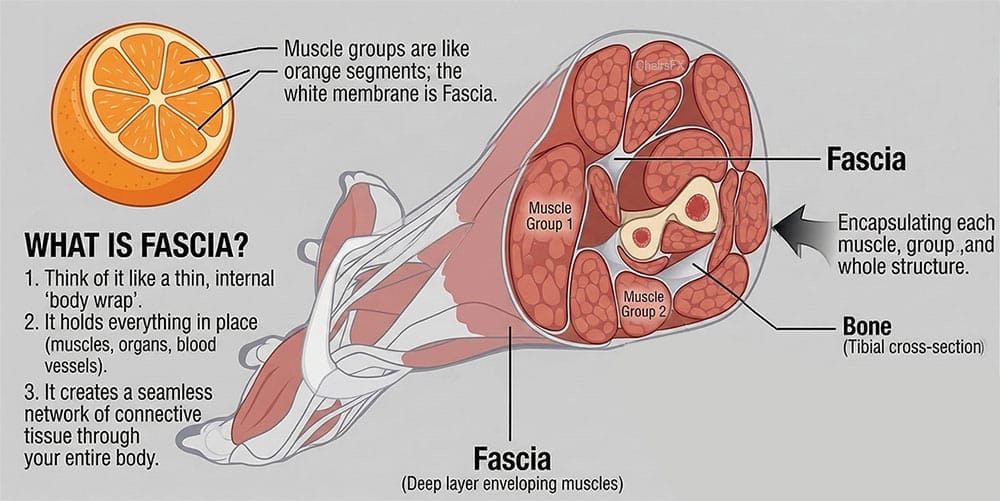
This works in both directions. With good posture, fascia hardens around muscles to fortify healthy positions, making it progressively easier to sit upright. With poor posture, the fascial network hardens in the wrong spots instead.
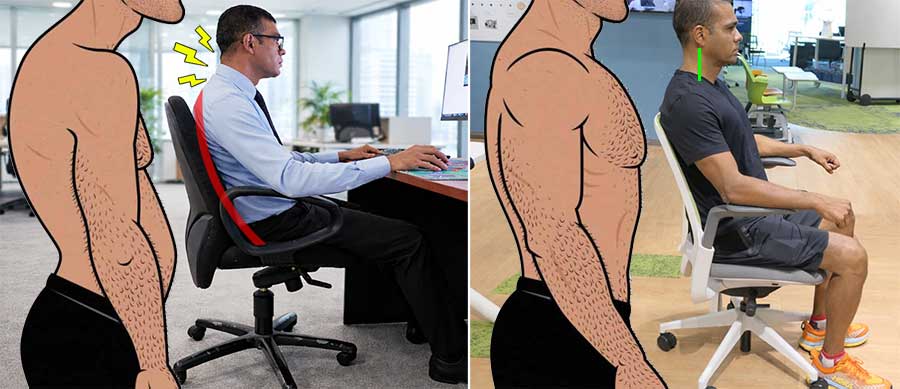
Desk workers in non-ergonomic chairs commonly develop tight lower backs as a result. Text neck is another example — it distorts and hardens soft tissues and joints in the cervical spine, placing intense pressure on the spinal cord and nearby nerve roots.

The reverse is equally true. Commit to neutral sitting consistently and your muscles will adapt — then your fascial system will harden to support those positions, making good posture progressively easier to maintain. With enough practice, it becomes entirely subconscious.
Muscles And Fascia Hold Tactical Memories
Muscle memory has been a staple of fitness science for decades. The general principle: build significant muscle once, and rebuilding after a break happens faster — because your muscles remember the process.
The mechanism behind this lies in myonuclei. Unlike most cells, which have a single nucleus, muscle cells have several. Exercise strains muscles to the point of micro-damage, triggering the addition of new cells and myonuclei to repair and strengthen the tissue — a process known as hypertrophy.
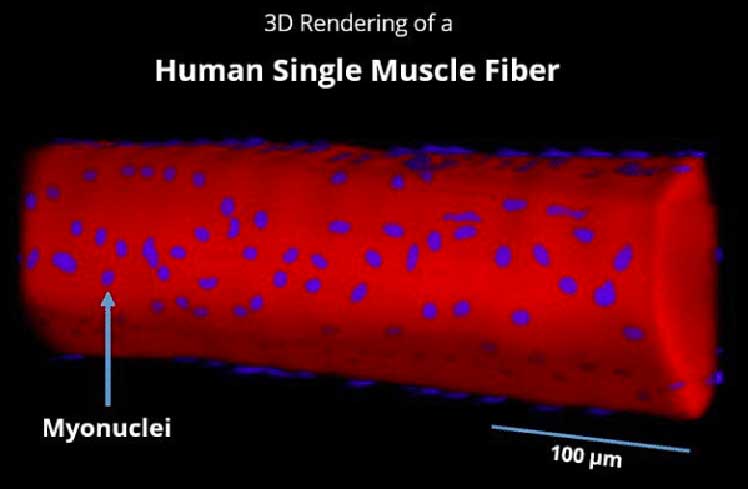
When you stop exercising, muscle proteins are lost through atrophy — but myonuclei remain intact for as long as 15 years.(8) That’s the biological basis of muscle memory.
A growing body of research suggests the fascia holds memories too. Each cell in the fascial network sends and receives signals containing both memory and mechanometabolic information — helping the system anticipate and adapt to changes in its environment.(9) Most fascia memory research remains speculative, but the implications for posture retraining are significant.
The bottom line: both muscles and fascia have the ability to adapt, encode, and remember. The more consistently you practise good posture, the more quickly it becomes a subconscious default — and once encoded, muscle memory can hold those patterns for years.
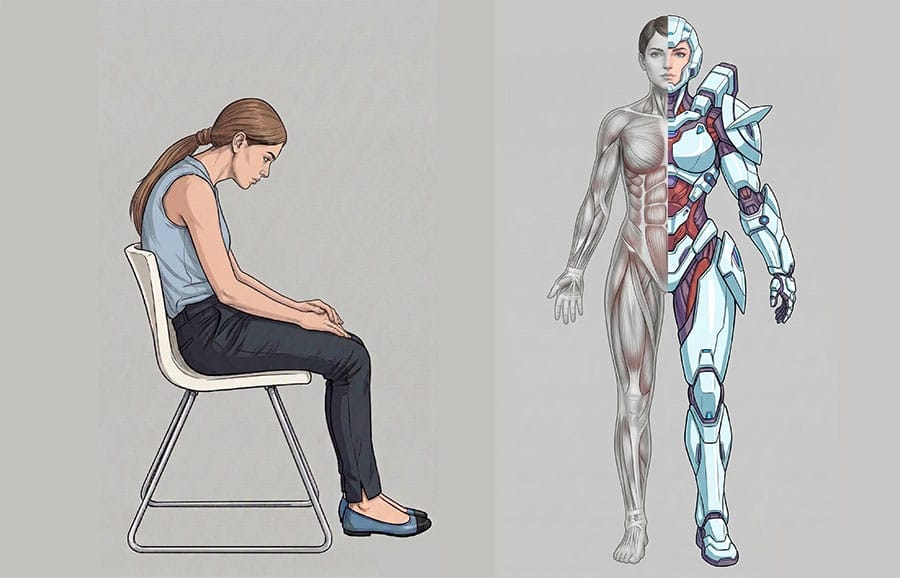
This is the basis of treating your body like an upgradeable mecha suit. As Dr. Snowden advised, the key is to “train the body to know what the proper movement is.” The upgrade process works like this:
- Upload the instructions: learn and apply neutral sitting posture.
- Run the program: hold neutral posture consistently while the fascia adapts.
- Hardwire the upgrade: muscle memory encodes the position as default.
- Maintain the system: 50% neutral posture keeps the memory intact.
- Enjoy the result: good posture on near-autopilot for 15+ years.
Conclusion: Your Body, Reprogrammed
The human body adapts to the positions it holds most often — and muscles and fascia memorise those positions to run on autopilot. By understanding that mechanism and applying ergonomic targets consistently, you can deliberately reprogram your defaults.
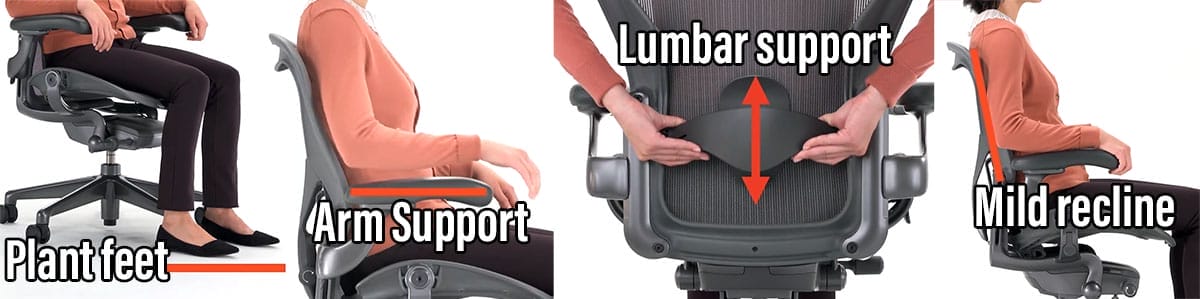
The formula is straightforward: a chair with the three core ergonomic components, a grasp of neutral posture technique, and around two weeks of discipline.
Supplement that with core strengthening exercises and the process accelerates. Once encoded, muscle memory can hold those patterns for years — requiring as little as 50% neutral posture to maintain.
Formula: Ergonomic Chair + Neutral Posture + Core Strength = Good Posture on Autopilot
The only remaining question is which chair suits you best. Mid-back office chairs enforce precise neutral postures by design. Gaming chairs offer the same core support with added recline flexibility for comfort.
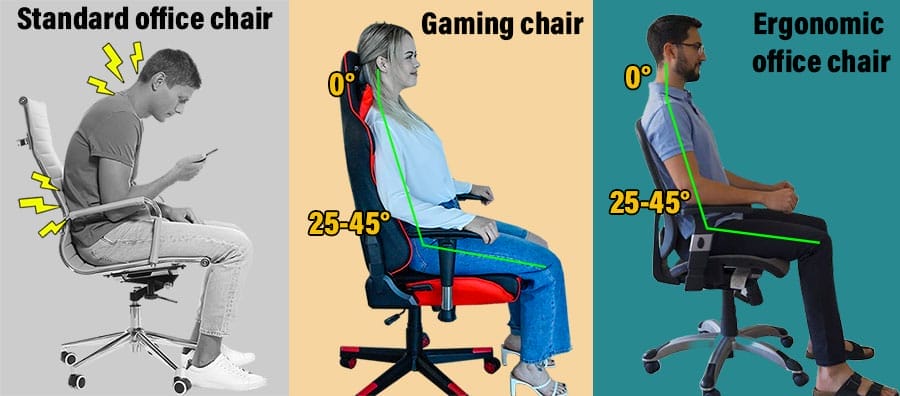
Both work. The difference is in style and flexibility — not effectiveness. With consistent neutral sitting habits, regular exercise, and a healthy lifestyle, either will serve you well. Which suits you better?
Gaming Chairs Vs Ergonomic Office Chairs: Flexibility Vs Focus
Footnotes
- Chris Watts. ‘What is fascial fitness, and why should we care?’ News & Trends, July 11, 2019. https://www.scmp.com/magazines/style/news-trends/article/3018002/what-fascial-fitness-and-why-should-we-care, (accessed 7 March 2026).
- Camilla Ranje Nordin. ‘Collagen’. The Fascia Guide, February 8, 2024. https://fasciaguide.com/fascia-anatomy-physiology/collagen/, (accessed 9 March 2026).
- Karen Gerberry. ‘How Avoiding Back Pain Could Be As Basic As Muscle Memory’. July 23, 2019. https://blog.vingapp.com/how-avoiding-back-pain-could-be-as-basic-as-muscle-memory, (accessed 9 March 2026).
- ‘Musculoskeletal conditions’. WHO Fact Sheets, 8 February 2021. https://www.who.int/news-room/fact-sheets/detail/musculoskeletal-conditions (accessed 9 March 2026).
- Dr. Stephen Gluckman. ‘Chronic Fatigue Syndrome’, Perelman School of Medicine at The University of Pennsylvania, September 2021. https://www.msdmanuals.com/professional/special-subjects/chronic-fatigue-syndrome/chronic-fatigue-syndrome, (accessed 9 March 2026).
- Karen Angelo. ‘New Research Links Stress at Work to Unhealthy Lifestyles’, Umas Lowell, 2 Feb. 2016, https://www.uml.edu/news/stories/2016/workerstress.aspx, (accessed 9 March 2026).
- Chris Watts. ‘What is fascial fitness, and why should we care?’ News & Trends, July 11, 2019. https://www.scmp.com/magazines/style/news-trends/article/3018002/what-fascial-fitness-and-why-should-we-care, (accessed 9 March 2026).
- J C Bruusgaard, et al. ‘Myonuclei acquired by overload exercise precede hypertrophy and are not lost on detraining’ Proc Natl Acad Sci USA, 2010 Aug 24. https://pubmed.ncbi.nlm.nih.gov/20713720/, (accessed 9 March 2026).
- Bruno Bordoni, et al. ‘The Awareness of the Fascial System’. Cureus. 2018 Oct 1;10(10):e3397. DOI: 10.7759/cureus.3397, (accessed 9 March 2026).
