

Most people with text neck syndrome don’t know they have it. I didn’t. No pain, stiffness, or obvious symptoms. It took a simple side-profile photo to reveal what mobile phone use had done to my neck and upper spine. This is the story of how I discovered my text neck problem—and fixed it in two weeks. My tools: neutral posture biomechanics, a Secretlab Titan gaming chair, guidance from three esports doctors, and muscle memory principles.
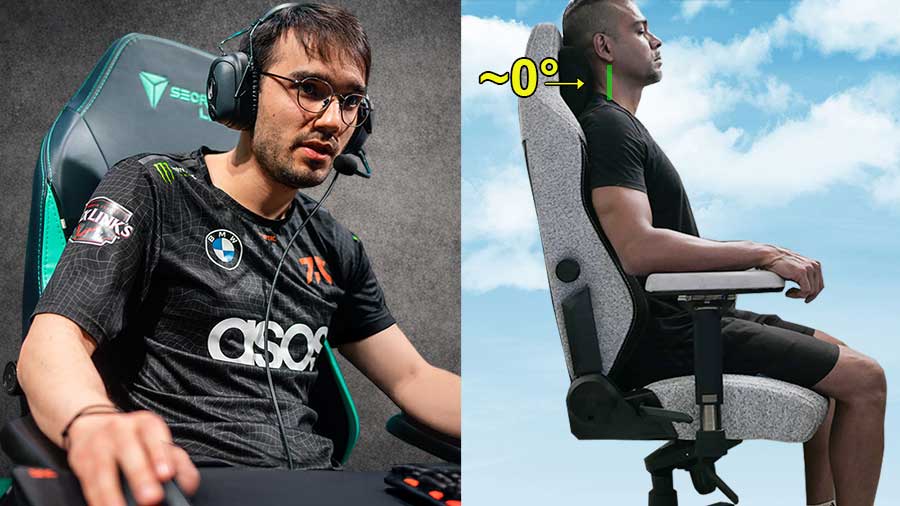
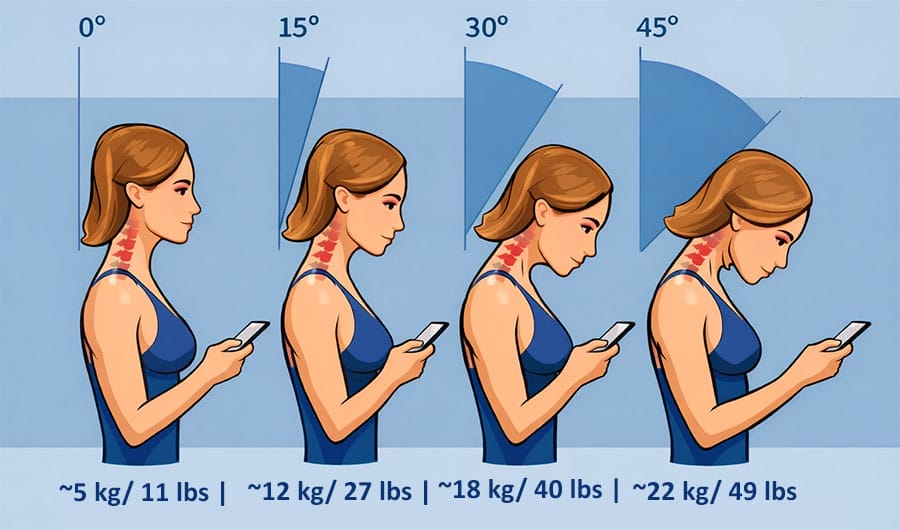
In a healthy neutral posture, the head naturally balances atop the shoulders with a ~0° tilt. When people use mobile devices, they often tilt their heads forward.
Text neck syndrome refers to the pattern of neck pain and structural changes caused by prolonged forward head posture during device use.
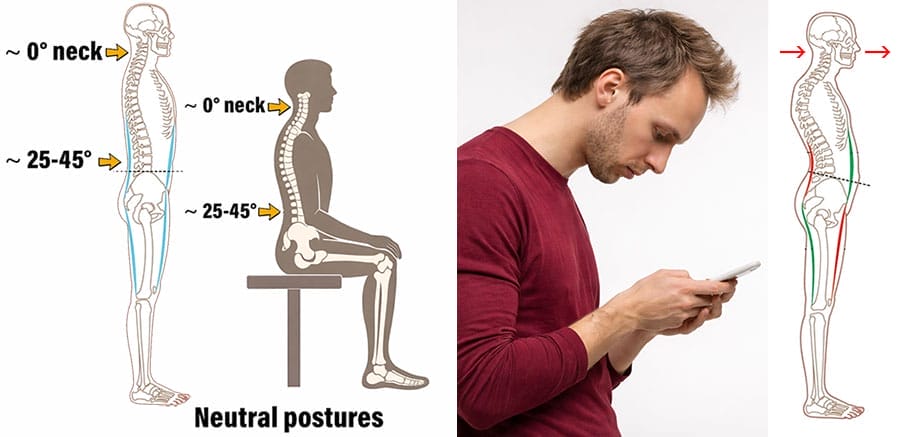
Because it develops habitually, changes tend to happen so gradually that they go unnoticed—often until structural adaptations have already occurred(1).
When I realized I had text neck, I formed a plan: use mobile neutral-posture benchmarks—and discipline—to retrain my kyphotic (hunched) muscle memory toward a healthy neutral baseline.
Quick Summary: My Text Neck Fix
Gaming Chair Method: (for mid-back office chairs, see alternative method)
- Objective: “Reprogram” muscle memory to replace a habitual forward head posture with a neutral, balanced neck position.
- Chair setup: ~100° backrest recline (almost upright), lumbar support slightly above the beltline
- Body position: Feet planted firmly, weight leaned into the headrest (maintaining contact at nape of neck)
- Tactile feedback: Use the headrest against the back of your neck as an indicator. When it loses contact, it means your head has tilted forward.
- Result: ~0° neck tilt with head naturally balanced over shoulders
Timeline: In my experience, muscle memory adaptation occurs within 5–14 days of consistent practice. After that, maintaining a healthy neck posture becomes automatic.
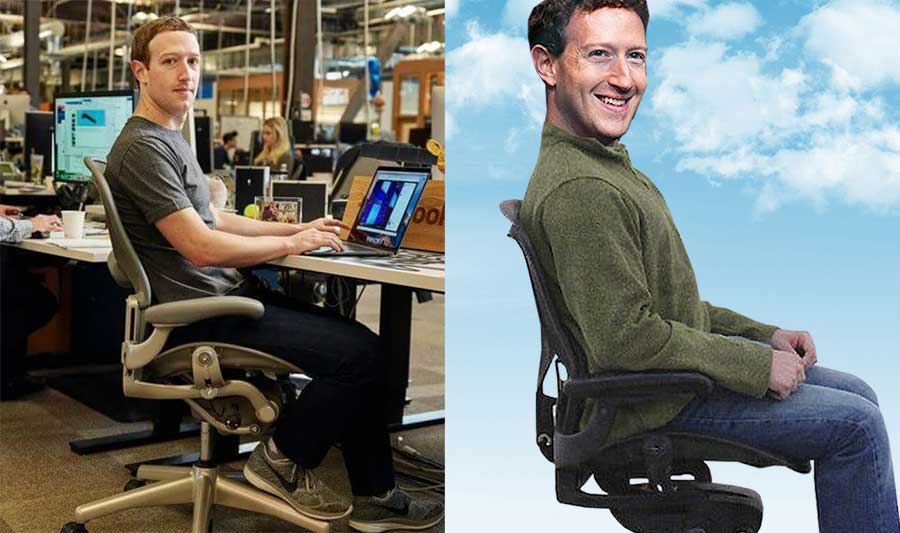
Note: This method requires reasonably strong back muscles. If maintaining an upright position feels impossible, strength training may be necessary first.
Related: Celebrities With Text Neck vs Celebrities With Good Neck Posture
My Self-Diagnosed Text Neck Problem
In March 2022, I started research on the original version of our Text Neck article. Its concept: excessive mobile phone use forces a severe forward neck tilt. Over time, this can distort the upper spine into a kyphotic (hunched) state.
To test my own upper back status, I removed the headrest from my Secretlab Titan Evo gaming chair and took two side-profile photos:
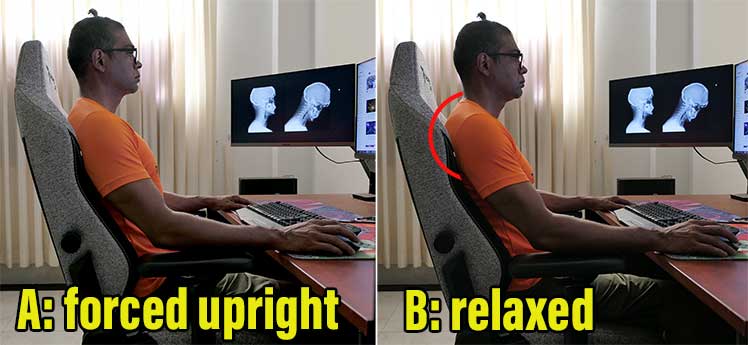
- Left photo: Consciously straining every muscle to sit as straight as possible
- Right photo: Completely relaxed, natural sitting posture
The results were sobering. In my relaxed state, my head clearly tilted forward, while my upper back rounded into a visible curve. I had text neck syndrome—and I’d never felt a thing.
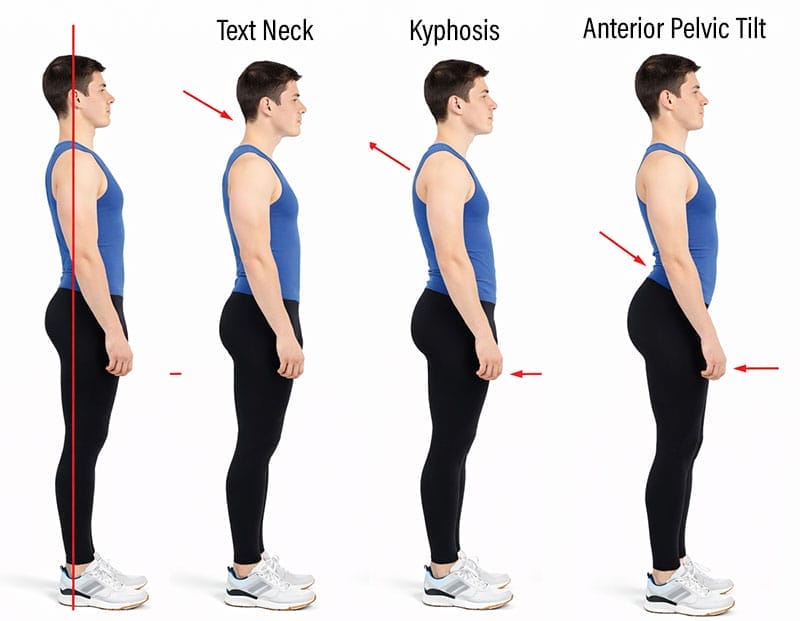
This is the insidious nature of text neck: it doesn’t hurt until it’s severe. The body gradually adapts to poor posture, making it feel normal. By the time pain appears, structural changes may already be significant(1).
Text Neck Advice From 3 Esports Docs
After diagnosing myself with text neck, I reached out to esports physical therapy specialists. These doctors work with professional gamers who face intense desk work challenges. I sent them my photos and asked:
- Does the Secretlab Titan support a ~0° neutral neck posture? How?
- Is sitting with a ~0° neck tilt good for my back health?
Dr. Tsai: Use a 100° Recline
Dr. Jordan Tsai is an LA-based esports doctor who has consulted for major pro teams like Evil Geniuses and Cloud 9. He also serves on Secretlab’s Ergonomics Advisory Board(2).
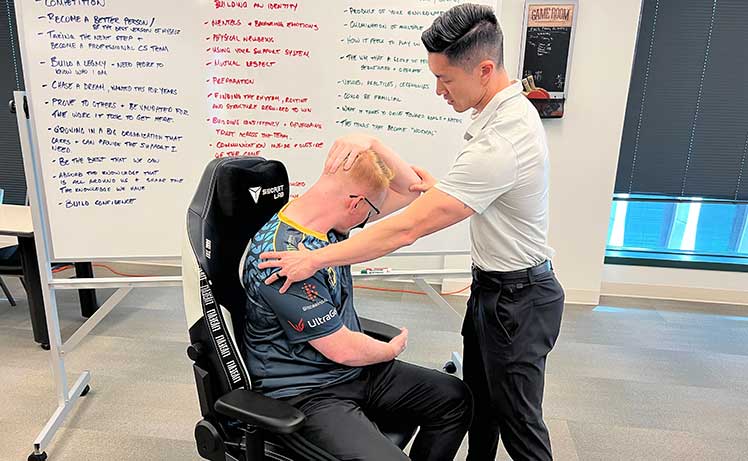
I asked him if the Secretlab Titan chair could actively support a ~0° neutral head tilt, and sent him two photos.
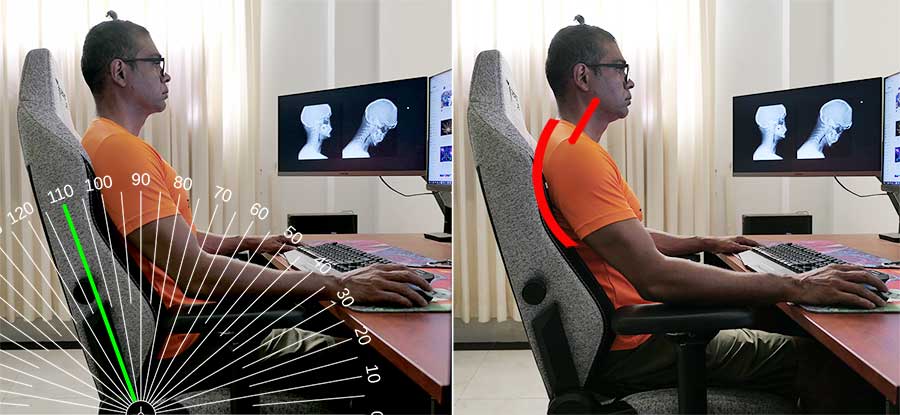
He replied that it’s “perfectly achievable using the neck pillow.” My problem was my backrest recline: its ~110° setting was too deep to actively support my neck. He also suggested not putting too much focus into ‘perfect’ postures:
Applying Dr. Tsai’s Advice
To reach my ~0° neck target, Dr. Tsai advised me to reduce my backrest recline to ~100° and sit upright enough for my neck to cradle into the headrest. It worked!
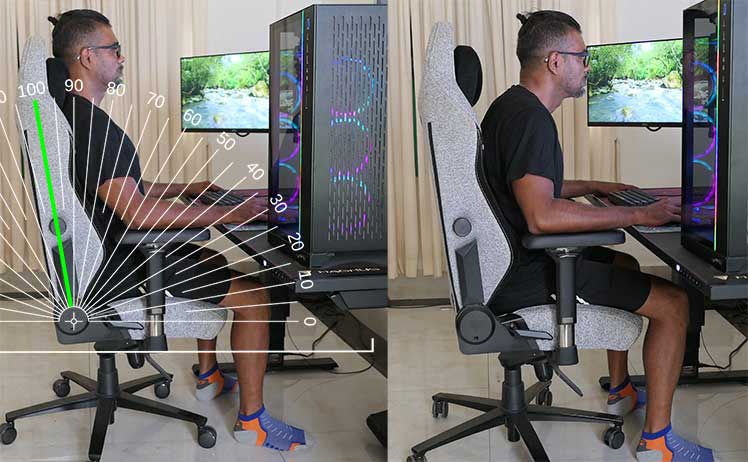
However, I felt a disconnect. Sitting up to press my neck into the headrest felt stiff and unnatural, while tilting forward felt comfortable. My muscle memory had adapted to poor posture so gradually that slouching felt “correct.”
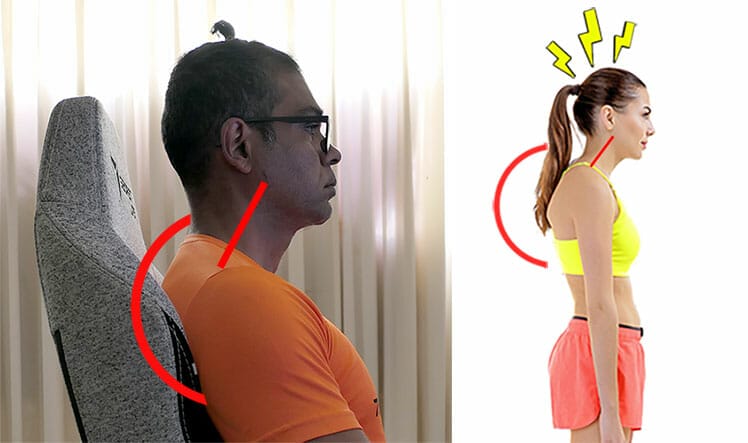
This adaptation occurs through fascia, the body’s connective tissue network that surrounds muscles and organs. Research shows that fascia continuously remodels itself based on the positions we hold most frequently.(3)
Despite my disconnect, I chose to trust neutral posture benchmarks over my comfort instincts. With no pain to stop me, I persevered. After about five days, the forced upright posture started feeling natural.
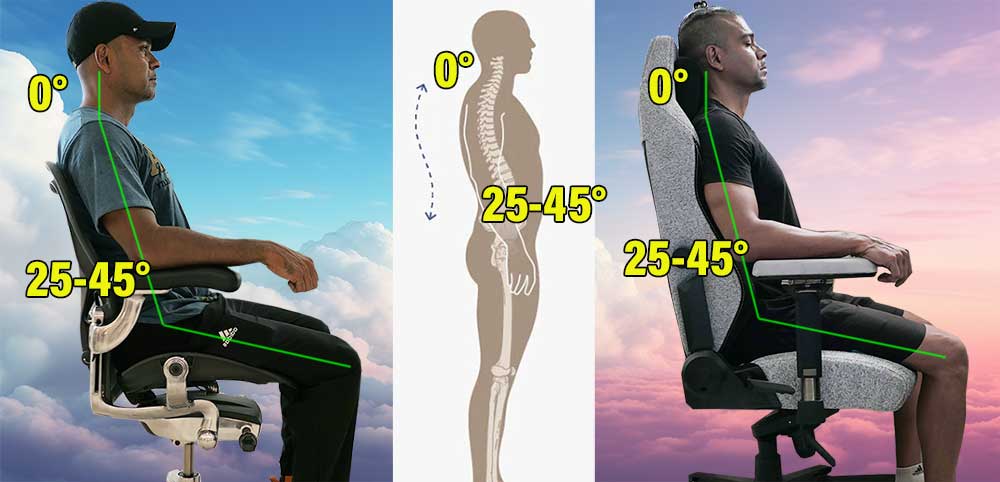
I also noticed improved body awareness—I could now sense when my head balanced over my shoulders versus when it tilted forward—while sitting and standing.
Dr. Smithson: Build Strong Back Muscles
After learning how to configure my chair, the challenge of maintaining an active upright posture led me to consult a second expert. Dr. Elliot Smithson works with 1-HP.org, one of the top esports therapy operations in America.

He confirmed my 100° recline + headrest = 0° neck formula was biomechanically sound as a ‘posture reset’—but warned that maintaining it would be difficult.
Instead of struggling to sit with a sharp active neutral posture, he suggested addressing the root cause: “Strengthening back muscles is the best way to improve posture long term.”
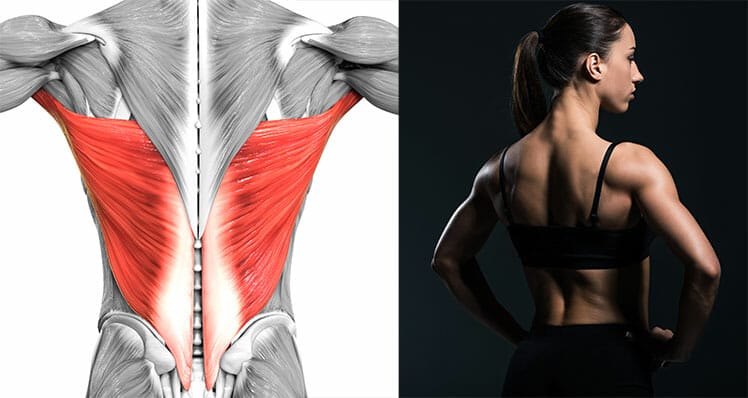
How I used his advice: Since Dr. Smithson confirmed my setup was biomechanically suitable, I committed to the experiment—but added pull-ups to my workout routine four times per week to build back strength.
Dr. Duncan: Active vs Passive Support
A third expert helped me understand why maintaining upright posture felt so unnatural. Dr. William Duncan runs Southeast Physical Therapy in Georgia, serving both esports and traditional athletes with an emphasis on optimal body mechanics.

When I showed him my posture photos, he explained why Position B (relaxed, forward-tilted) felt more comfortable than Position A (upright):

This explained my exact experience: slouching felt easier because I was using passive support (bone structure) instead of active support (muscle engagement). My muscles had atrophied from disuse, making active posture feel strenuous.
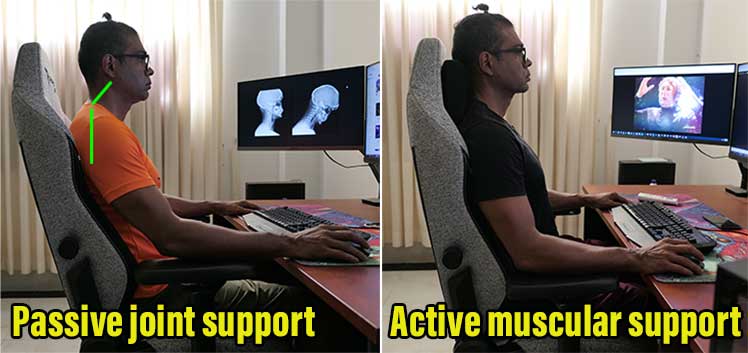
Dr. Duncan warned that continuing to rely on passive support would backfire: “It is going to cause compensatory patterns (tissues over or underperforming their tasks). If these patterns go on long enough they’ll eventually result in pain.”
Key takeaway: Dr. Duncan’s conclusion reinforced Dr. Smithson’s: the chair could guide my posture, but my muscles had to do the work.
Text Neck Fix Results
With biomechanical validation from all three experts, I committed to my active posture rehabilitation. After two weeks, sitting upright with a ~0° neck posture felt comfortable and automatic.
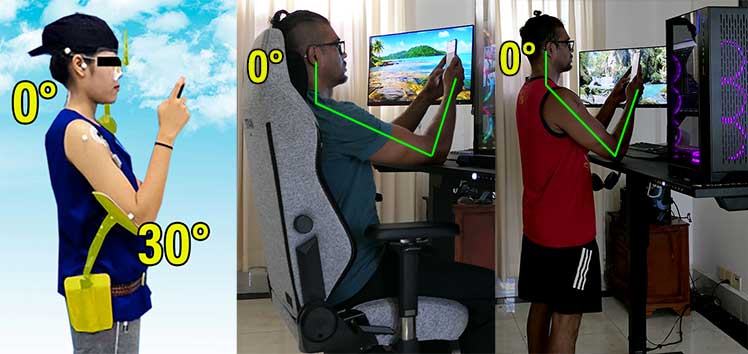
To reinforce the habit beyond seated work, I used mobile computing biomechanical benchmarks and a Magnus Pro standing desk to support mobile computing with raised elbows.
Adaptation timeline
- After one month: I experienced upper back and neck pain—not sharp or acute, but the type that follows a strenuous workout. Though not a medical expert, I recognized it as muscle soreness from engaging previously underused stabilizers. The discomfort peaked over several days, then receded and disappeared completely.
- After one year: The habit locked in. Active neutral posture with ~0° neck tilt became automatic during both seated work and mobile device use. When I occasionally got sloppy, mild pain arose—not workout soreness, but the negative type from imbalance. This biofeedback reminded me to return to neutral alignment.
- After four years (present day): The ~0° neck habit persists across all activities—computing, walking, traveling, socializing, sports. I still occasionally slip into poor posture, but pain warnings continue functioning as reliable correction signals to restore spinal alignment.
Structural Changes
- Height gain: Approximately 2cm increase in standing height
- Improved standing posture: Seated muscle memory transferred directly to standing alignment
- Greater body awareness: Ability to sense head position relative to shoulders became second nature
~0° Neck Tilt In an Office Chair
Based on my own tests, office chairs take a different approach than gaming chairs. While gaming chairs like the Titan Evo offer flexible sitting styles with deeper reclines, the typical ergonomic office chair maintains a clean, upright positioning as the primary mode.
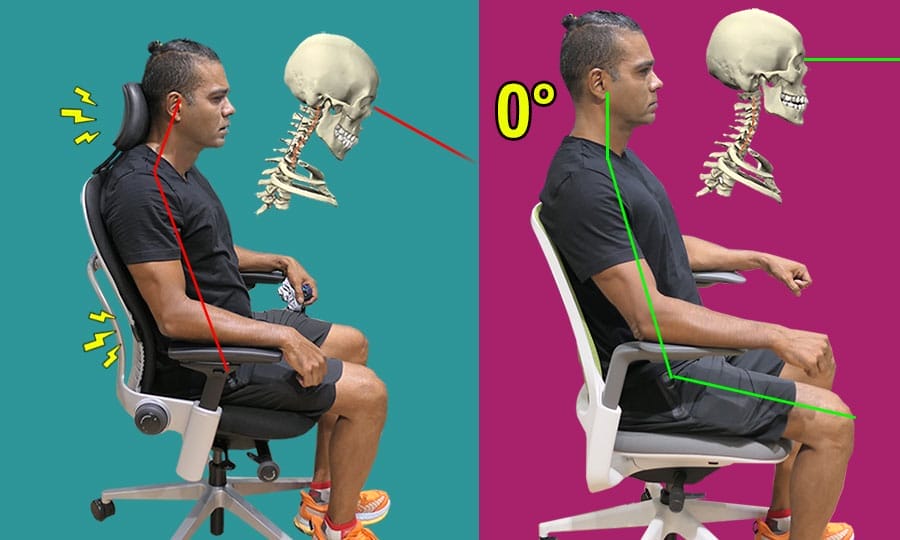
The only trick is to remove the headrest. Office chair headrests are designed for deeper reclines. When used upright, they push the head forward, reinforcing the exact forward head posture you’re trying to correct.
Step-by-Step Office Chair Method (Headrest Removed)
- Set backrest recline to ~100° (typically the default upright position)
- Adjust lumbar support slightly above your beltline
- Plant both feet firmly on the ground
- Sit back into the lumbar support
Without a headrest to lean against, your head should naturally self-balance atop your shoulders. This forces active neck engagement. After a few days of practice, your muscle memory will start to adapt.
However, as with a gaming chair, success depends on proper chair configuration and user effort. As an example, in the images below, I’m sitting unconfigured on the left and configured on the right in a Steelcase Series 1.
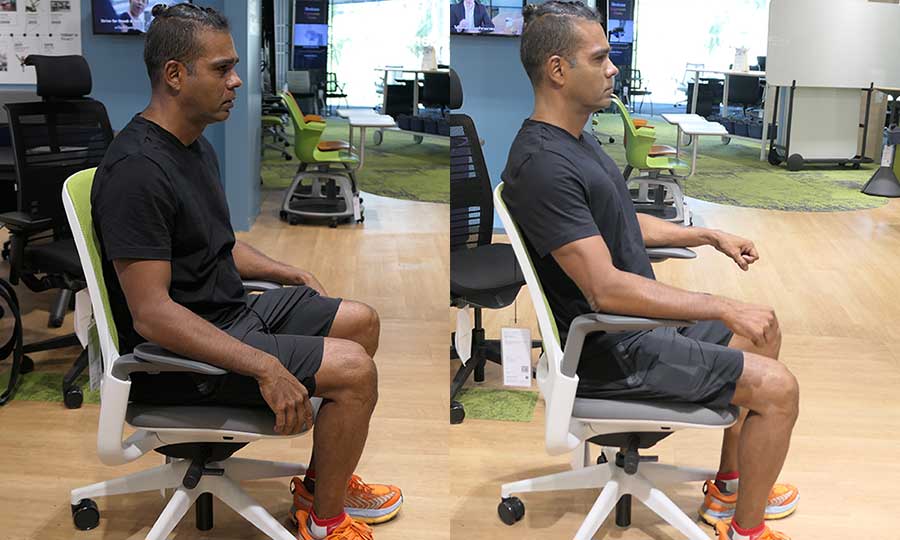
- Left: The seat and lumbar support are set too low. I’m sitting ‘naturally’, making no conscious effort to engage my back muscles.
- Right: I set the seat height slightly higher than my hips to support a ~95° knee bend, and the lumbar slightly above my beltline. I also consciously engaged my back muscles to sit upright in a clean neutral posture.
Key takeaway: As with a gaming chair, you’ll need to configure your office chair properly and consciously aim for a clean neutral posture. In both cases, you’ll need strong core and back muscles to hold your torso upright.
Key Text Neck Rehab Takeaways
This article is not medical advice. It’s a personal experiment that proves a hypothesis: muscle memory is programmable. If you hold the body in specific positions for long periods, muscles will adapt.
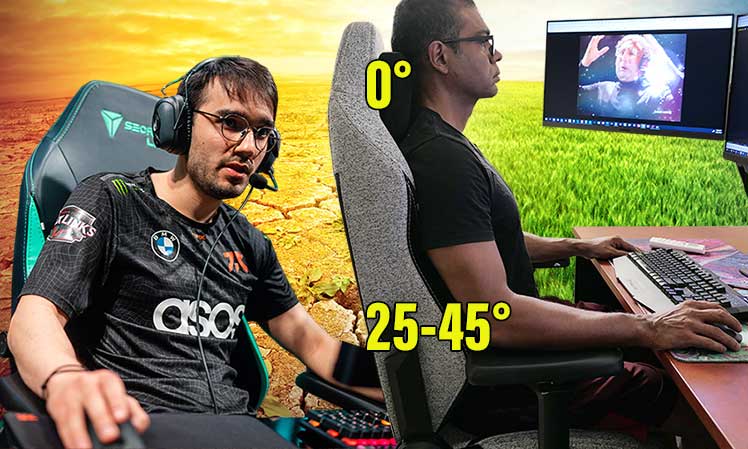
If you use your phone with a bent neck, you may be asymptomatically suffering from text neck syndrome. In contrast, if you sit for long periods with a ~0° neck posture, your muscles will adapt until that position becomes automatic.
Caveat: All three esports doctors warned that my ~100° recline + ~0° neck posture was overkill. Instead, they suggested users aim for a roughly neutral posture, mixed with plenty of movement.

All three also added that beyond posture, healthy habits is the most important thing to work on. Even so, my experience yielded some useful takeaways for ergonomic chair owners:
- Text neck can go undiagnosed. Absence of pain does not equal absence of a problem. I had no symptoms—only gradual postural drift that I had normalized. Side-profile photos revealed changes I couldn’t feel.
- Muscle memory adapts in about two weeks. In my experience, that’s how long it took to trigger adaptation. After that, a neutral neck posture felt automatic rather than forced.
- Back strength is essential. All three esports doctors emphasized this: chairs guide posture, but muscles sustain it. If upright sitting feels exhausting, strength—not furniture—is the limiting factor.
Final takeaway: Ergonomic chairs support healthy posture—but they don’t do the work for you. Learning how neutral posture feels allows you to return to it repeatedly. Over time, muscles adapt, fascia reinforces those positions, and posture will self-correct without conscious effort.
Acknowledgments
Special thanks to the three esports doctors who provided expert guidance for this article. If you need professional help with posture, pain, or movement issues, feel free to reach out:
- Doctor Jordan Tsai: founder of Respawn Therapy (works with Cloud9, TSM, Evil Geniuses, etc); Secretlab Ergonomics Advisory Board member. @DrJordantsai
- Dr. Elliot Smithson: DPT, PT, MS, ATC, EMT-b; physical therapist with 1-HP.org (works with G2, Team Liquid, 100 Thieves, Fnatic, etc). @1HP_Medic
- Dr. William Duncan: Doctor of Physical Therapy; owner of Southeast Physical Therapy; powerlifter; works with esports and traditional athletes.
Footnote
- Karthikeyan G, Sasidharan S, Rajeswaran S, et al. ‘Influence of Forward Head Posture on Cervicocephalic Kinesthesia and Electromyographic Activity of Neck Musculature in Asymptomatic Individuals’. Journal of Bodywork and Movement Therapies, Vol. 27, 2021. https://pmc.ncbi.nlm.nih.gov/articles/PMC7835487/, (accessed 10 Jan. 2026).
- Secretlab.co. ‘Ergonomics Advisory Board’. https://secretlab.co/pages/technology, (accessed 10 Jan. 2026).
- Bordoni B, Walkowski S, Morabito B, Varacallo MA. ‘Anatomy, Fascia’. StatPearls, National Center for Biotechnology Information, December 2024. https://www.ncbi.nlm.nih.gov/books/NBK493232/, (accessed 10 Jan. 2026).
